Calm — Practical
Last updated: December 30, 2025
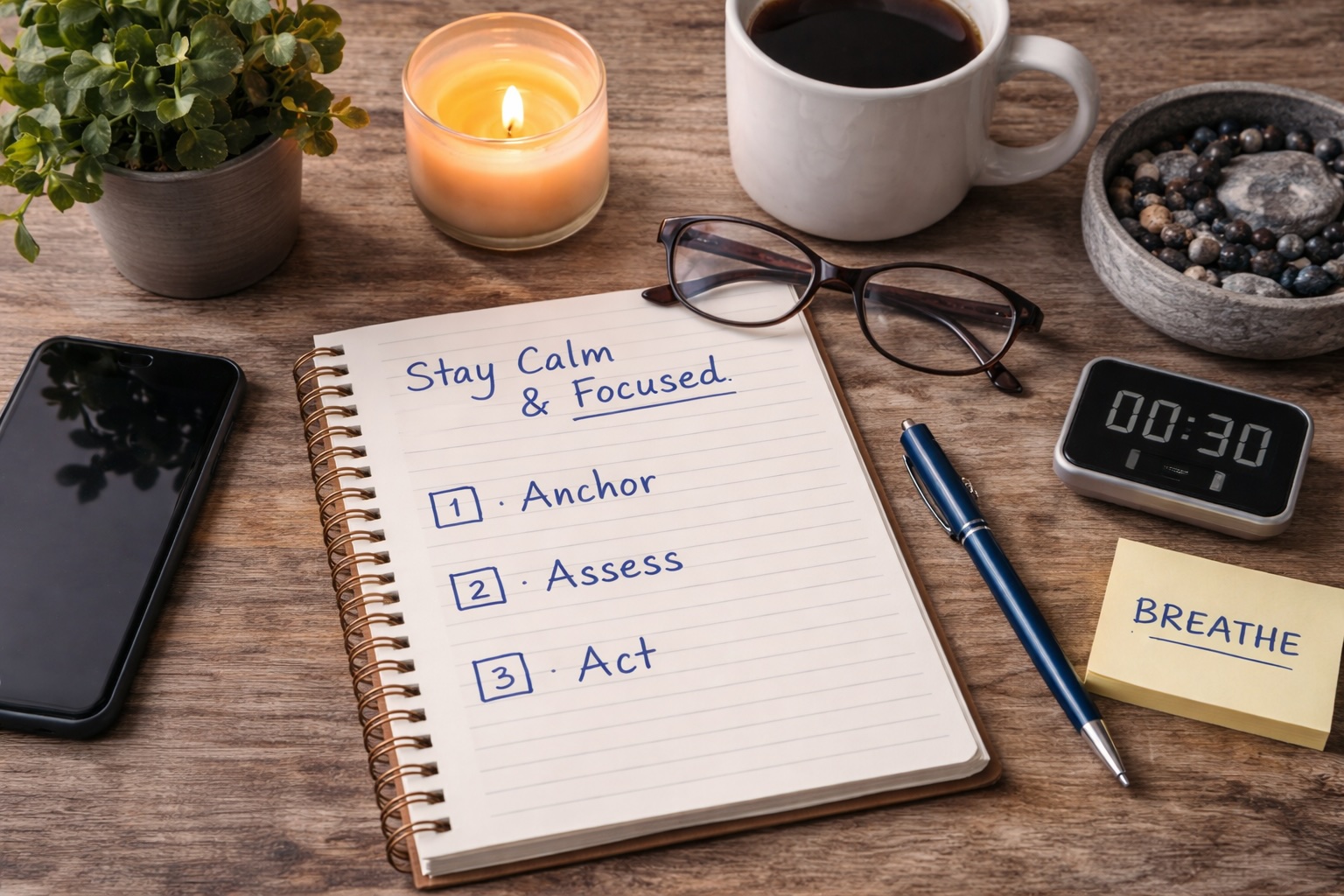
Calm under pressure is not a personality trait—it is a repeatable process. This guide provides a simple workflow for organizing information, making controlled decisions, and maintaining stability when situations become uncertain or fast-moving.
- Triage reduces overwhelm — separate now, next, and later.
- Verify before acting — avoid rumor-driven decisions.
- Protect optionality — check reversibility and downside.
- Clear communication stabilizes situations quickly.
Purpose
Provide a simple, repeatable workflow for maintaining clarity under pressure. The goal is to organize information, prioritize decisions, and act in a controlled way that preserves stability and reduces unnecessary risk.
Calm is a workflow
Practical calm is a workflow. In high-pressure situations, the goal is not perfect thinking, but stable execution: reduce noise, make one clear decision, and move forward with control.
Triage creates order
- Now: immediate safety, time-sensitive actions, irreversible decisions
- Next: actions that reduce risk or increase options
- Later: opinions, arguments, and decisions that can wait
Information discipline
- Two-source rule: confirm before acting
- Primary over viral: prioritize direct, reliable information
- Time awareness: outdated information creates unnecessary urgency
Decision checkpoints
- Reversibility: can this be undone?
- Downside: what happens if this is wrong?
- Optionality: does this expand or reduce future choices?
- Failure points: what breaks first?
Calm communication
- Boundary: “I’m not deciding this right now. Let’s revisit later.”
- Alignment: “We’re aiming for safety and stability.”
- Clarity: “What is the one decision we need to make?”
- Pause: “Give me a moment to think.”
A short reset
- Body: slow breathing, release tension
- Write: identify the main concern
- Choose: take one option-improving action
- Communicate: share a clear next step
Feedback loop
Calm improves through reflection. After a stressful moment, review what triggered the reaction, how you responded, and what can be improved next time.
Next steps
After applying these practices, return to Calm — Foundations to reinforce your baseline.
This article focuses on decision-making and stress regulation, not medical advice.