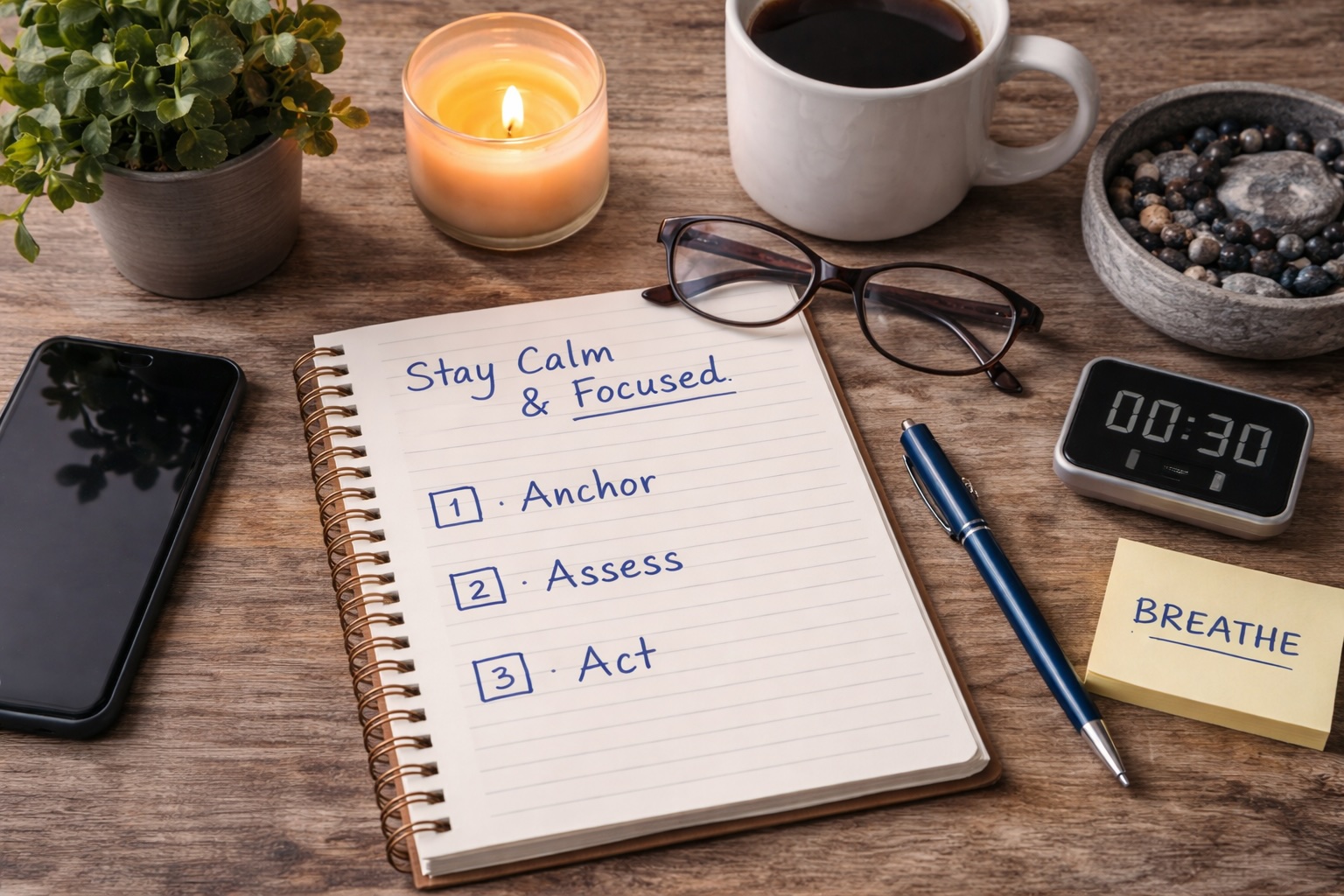
Quick take: Practical calm is a workflow: stabilize state → triage information → decide one thing → communicate clearly → follow through.
1) Triage with “Now / Next / Later”
- Now: immediate safety, time-sensitive commitments, irreversible decisions.
- Next: actions that reduce risk or increase options (calls, backups, documentation).
- Later: opinions, arguments, and anything you can revisit after 24 hours.
2) Information security without paranoia
- Two-source rule: don’t act on a claim unless confirmed by two independent sources.
- Primary beats viral: prefer official statements, direct evidence, and local confirmation.
- Timestamp everything: old information recycled as “new” causes needless panic.
3) Decision checkpoints
- Reversible? Can I undo this in 24–72 hours?
- Downside cap: If I’m wrong, what’s the maximum damage?
- Option value: Does this increase options or shrink them?
- Failure points: What breaks first? What breaks second?
4) Calm communication scripts
- Boundary: “I’m not deciding this while we’re heated. Let’s revisit at 6pm.”
- Alignment: “Same goal: safety and stability. Let’s agree on the next step.”
- Clarity: “What is the single decision we need to make right now?”
- De-escalation: “I hear you. Give me two minutes to think, then I’ll respond.”
5) A 15-minute reset
- Body (3 min): slow exhale breathing, shoulders down, drink water.
- Write (4 min): list top 3 worries; circle one you can influence today.
- Choose (4 min): pick one “options-increasing” action.
- Communicate (4 min): tell one person the plan in one paragraph.
6) After-action reflection
Calm improves with feedback. After a stressful moment, do a fast debrief: trigger → response → upgrade.