Food — Clarity
Last updated: April 2026
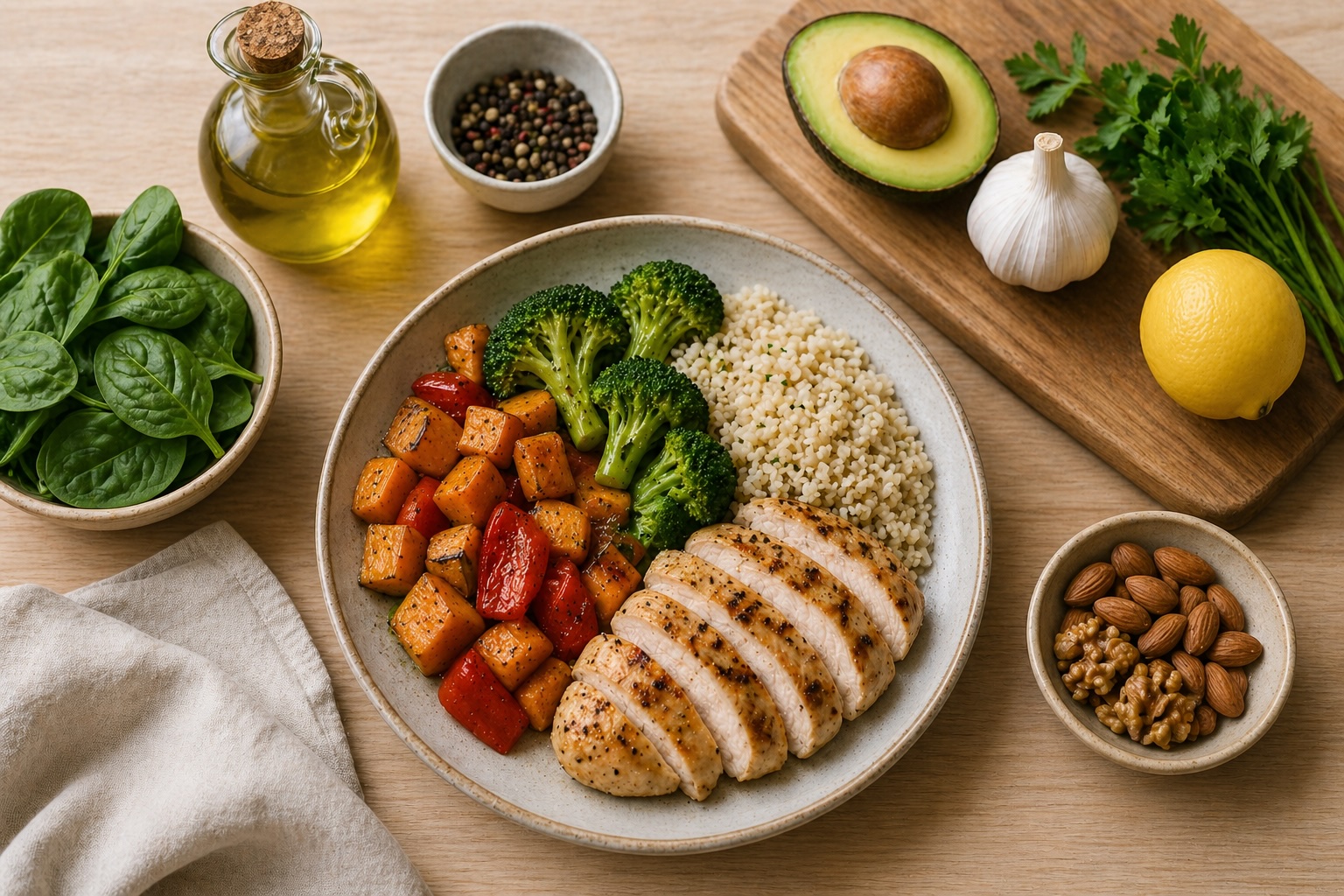
Food is one of the most visible parts of daily life and one of the most overcomplicated. It is often treated as a problem to solve rather than a system to stabilize.
- Daily meals matter more than perfect diets — what you eat regularly has the greatest effect.
- Repeatable meals reduce decision fatigue — simple patterns make consistency easier.
- Stable energy matters more than optimization — meals should support the day, not complicate it.
- Simple systems outperform complex plans — food that is easy to prepare is more likely to be repeated.
Purpose
Provide a simple framework for thinking about food that prioritizes consistency, stable energy, and ease of execution over complexity.
The problem is not nutrition
Most people already understand the basics of nutrition.
They know that whole foods are generally better than processed ones. They know that protein, fiber, and hydration matter. They know that consistency is important.
Yet despite that knowledge, food decisions are often inconsistent.
The problem is not a lack of information. It is the difficulty of applying that information in a repeatable way.
What actually matters
At a practical level, food can be reduced to a few core factors:
- Consistency: what you eat regularly matters more than what you eat occasionally.
- Energy: meals should support stable energy, not spikes and crashes.
- Simplicity: the easier a meal is to prepare, the more likely it is to be repeated.
When these are in place, most nutritional questions become easier to manage.
Where people go wrong
When thinking about food, it is common to focus on optimization:
- searching for the perfect diet
- maximizing variety
- following complex meal plans
- switching approaches frequently
While these can seem productive, they often create friction.
The result is a system that is difficult to maintain, leading to inconsistency over time.
More effort does not necessarily lead to better outcomes.
A simpler approach
Clarity in food systems comes from reducing decisions and building repeatable patterns.
This can be done by:
- Using base meals: a small set of meals that can be prepared easily and consistently.
- Standardizing ingredients: keeping core items on hand that work across multiple meals.
- Simplifying preparation: choosing cooking methods that are reliable and low effort.
A simple combination such as protein, a base carbohydrate, and a small number of supporting ingredients can cover most needs.
The goal is not to eliminate variety, but to make variety optional rather than required.
Stability over optimization
A simple meal that you prepare regularly is more valuable than a complex meal you rarely make.
Clarity comes from knowing:
- what you will eat
- how to prepare it
- how it will affect your energy
When these are predictable, food becomes a stable part of the day rather than a recurring decision.
Optimization can come later. Stability should come first.
How this fits the broader system
Food does not exist in isolation. It connects directly to other systems:
- Energy: stable meals support consistent physical and mental performance.
- Finances: simple, repeatable meals reduce unnecessary spending.
- Time: fewer decisions free up attention for other priorities.
- Decision-making: less variability reduces daily friction.
When food is stable, other areas become easier to manage.
What clarity looks like in practice
A clear food system is not complicated. It is defined by a few characteristics:
- You have a small set of meals you can prepare without effort.
- You keep the necessary ingredients available.
- You understand how those meals affect your energy.
- You can repeat the system without relying on motivation.
There is no need to build beyond what you can maintain.
Final thought
Food clarity is not about eating perfectly.
It is about eating simply in a way that works every day.
In most cases, that is enough.
Next steps
Continue with Food Resilience and related recipes. For the decision-making side, pair this article with Calm — Clarity.
This article focuses on practical food planning and decision-making, not medical or dietary advice.